


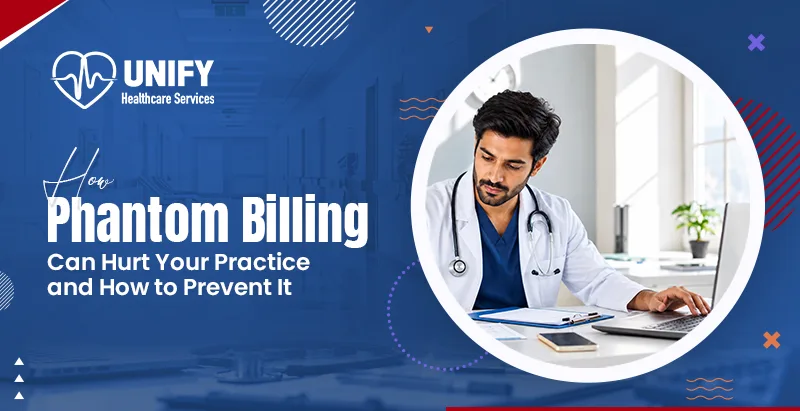
A healthcare industry with complete honesty and reliability is too good to be true. Potentially fraudulent actors enter administrative channels leading to phantom billing. It causes more damage than common fraud, affecting the financial health of providers, insurance companies, government programs, patients, and more. Healthcare RCM outsourcing provider helps deal with phantom billing and protect billions worth of money.
Phantom billing is not like billing errors that can happen by entering wrong codes. It is a deliberately submitted false claim to acquire revenue without even offering medical service. Financial loss is just one consequence of phantom billing; there can be administrative penalties, disciplinary action, fines, criminal prosecution, and more.
That’s why preventing such activities becomes crucial for healthcare providers and practices. In this blog, we will cover everything about this concept and learn how practices can optimize their workflow to avoid severe outcomes.
What Does Phantom Billing Mean?
When a patient or insurance company is charged for a medical service or a treatment that was not actually provided, it is known as phantom billing. It is considered a form of medical billing fraud and can lead to financial losses, legal problems, and penalties for healthcare providers.
How Phantom Billing Works and Why It is Difficult to Detect?
Sometimes phantom billing happens in plain sight, and practices are not able to detect it. Because it is difficult to detect, let’s explore how it works and how providers and practices can detect. The process of how phantom billing is executed is quite similar to any other billing process. The process looks very simple with the usual patient encounter, clinical documentation, coding, claim creation, claim submission, payer review, and revenue payment. Phantom billing takes advantage of this workflow by inserting a false service or charge into the process.
Let’s understand this with an example:
- Suppose a patient visits a physical therapy practice for one session and receives a singles session from the provider. However, at the time of creating billing claims, the patient was charged for five sessions on different days. Now, this is not legal if the patient has received only a single session but is paying for five sessions.
- If a single session costs $100, the legitimate reimbursement would be $100, but the claims seek $500 with the help of false claims.
- Phantom billing can be caused by the staff or the provider or any other middleman in the process. It can happen at any step of billing, starting from clinical documentation to coding, claim creation, and submission.
It is difficult to detect phantom billing!
There are some valid reasons behind this statement, and they are:
- In a normal scenario, claims can look completely fine because it includes real patients, real providers, and the real billing process.
- A fraudulent claim can resemble an ordinary claim, and it becomes difficult for insurance providers to detect it as they cannot physically verify each claim.
Also Read: Everything You Need to Know About Effective Claims Scrubbing
What is the Impact of Phantom Billing in 2026?
Even in 2026, phantom billing remains to be a concern for healthcare organizations, insurance payers, government schemes, and more. However, it is essential to not confuse phantom billing with errors and improper payments. Every improper payment or documentation issue cannot be covered under fraud.
The impact of phantom billing can be understood across financial, patient, provider, insurance, regulatory, and healthcare systems levels.
How to Prevent Phantom Billing in Your Healthcare Practice?
The best way to prevent phantom billing is to strengthen the tracking process within your workflow. It means building a system for billing that controls how every claim is submitted. There are measures taken by US healthcare which makes it mandatory for providers and practices to meet certain compliance principles. The approach may seem simple, but it must be consistent.
What’s the Role of a Medical Billing Company Reducing the Risk of Phantom Billing?
Medical billing companies play a crucial role in preventing phantom billing by verifying the entire billing process. They check every step of the billing process to ensure accuracy throughout documentation, coding, claim filing, compliance, and submission. Their process can detect false, duplicate, or unsupported charges.
Unify Healthcare Services offers billing services that strengthen billing accuracy, protect healthcare providers from fraud allegations, and ensure compliance with healthcare regulations. We also offer patient services billing to help you with all administrative aspects. For healthcare practices and providers searching for a better approach to improve their billing and prevent fraud, Unify RCM is the right option.
Frequently Asked Questions
Warning signs may include claims for services a patient never received, duplicate charges, mismatched treatment dates, unsupported procedures, or services that do not match clinical documentation. Practices should review unusual billing patterns and investigate discrepancies promptly to prevent potential fraud and reduce financial and compliance risks.
Yes, regular billing audits can help prevent phantom billing by identifying inconsistencies between patient records, documentation, codes, and submitted claims. Routine reviews provide practices with better oversight of their revenue cycle and can uncover unsupported or duplicate charges before they result in financial or regulatory consequences.
Medical billing companies can strengthen fraud prevention by reviewing claims, verifying documentation, checking coding accuracy, and identifying duplicate or unsupported charges. Their systematic billing processes provide an additional layer of oversight, helping healthcare practices improve claim accuracy, maintain compliance, and address potential billing issues before they become serious.
Yes, accurate documentation plays an important role in preventing phantom billing. Clear patient records provide evidence that a service was actually performed and support the information reported on a claim. Consistent documentation also allows billing teams to identify discrepancies and helps practices maintain stronger compliance and internal controls.
Unify Healthcare Services can help healthcare practices reduce fraud risks through structured medical billing and revenue cycle processes. Our team reviews documentation, coding, claims, and billing information to identify inconsistencies and unsupported charges. This additional oversight helps practices improve billing accuracy, strengthen compliance, and maintain more reliable financial operations.